Adzbyte
WordPress Publishing & Operations PlatformPlatform EngineeringPublishing SystemsWordPress

From custom theme to maintainable publishing platform

Reactive WP

I built AMFM Core to connect a polished, server-rendered public experience with the editorial controls, operational safeguards, and release tooling required to maintain it.

Role

Sole WordPress Developer and Maintainer

Timeline

January 2026–present

Status

Active, versioned, and observed in production

Client

Multi-site behavioral healthcare organization

Desktop homepage showing branded navigation, a two-column mental-health hero, supporting copy, calls to action, and lifestyle image; the private WordPress toolbar is blurred.

01 / The problem

A workflow that needed stronger engineering boundaries

A growing WordPress site needed consistent public components, flexible editorial controls, integrations, and safe operational tooling without becoming a collection of duplicated templates, one-off scripts, broad administrator access, or incompatible site-specific fixes.

  • Fragmented page components and inconsistent responsive behavior
  • Editors depending on developers for repeatable content patterns
  • Bulk imports and syncs changing live content without sufficient review
  • All-or-nothing admin access to sensitive maintenance actions
  • Legacy slugs, saved keys, and API contracts breaking during architectural cleanup
  • Production and staging installations drifting without a controlled release path
02 / The approach

Design the workflow around explicit invariants

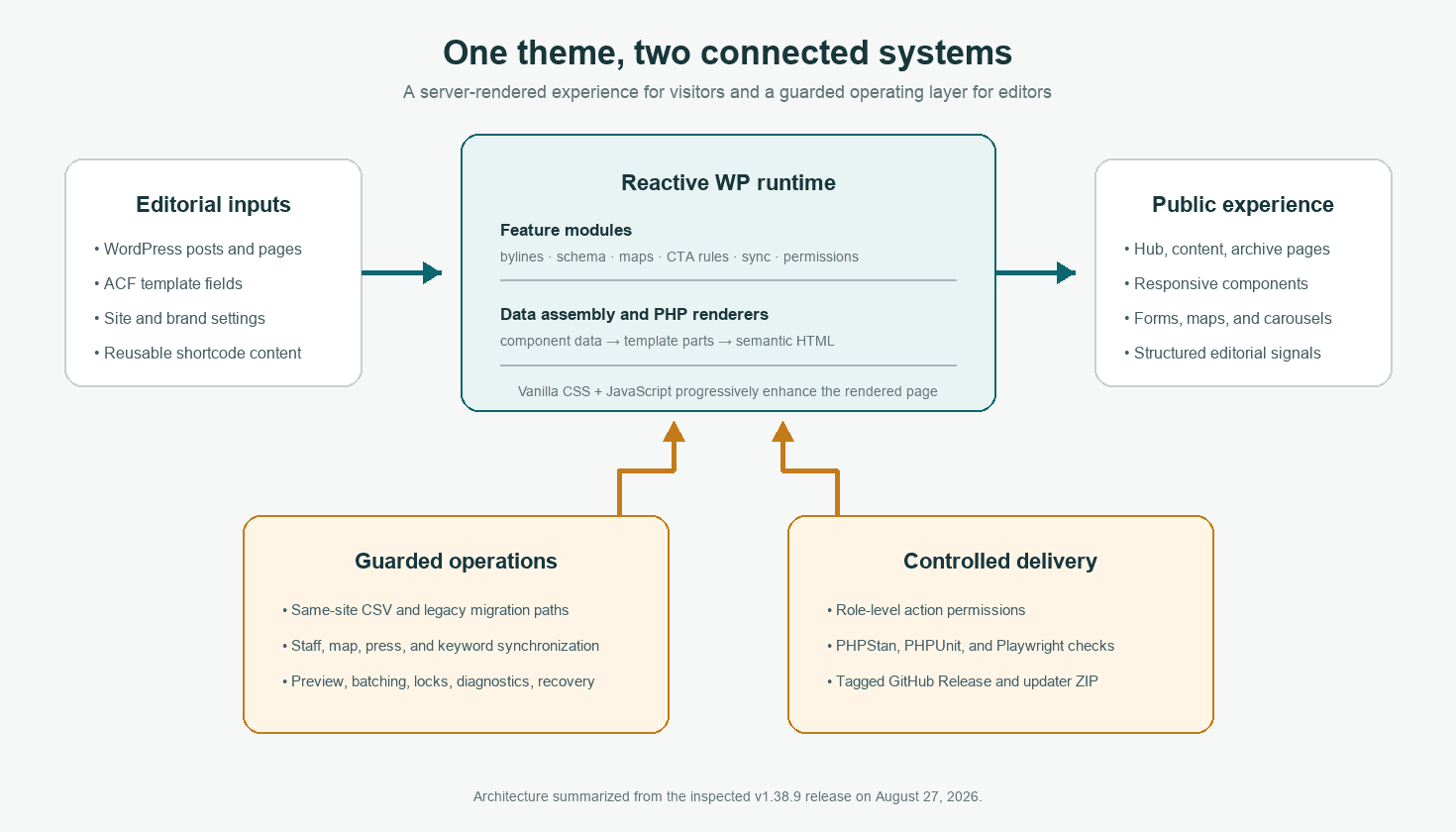
Treat WordPress as the application platform: model content with ACF, assemble it through shared data functions and feature modules, render semantic PHP components, progressively enhance interaction with vanilla JavaScript, and expose operational work through guarded WordPress-native interfaces tied to a tested release pipeline.

  • Server-rendered experience: PHP templates and 26 component partials render the core interface before JavaScript enhancement.
  • Governed editorial reuse: Template-specific ACF fields, shared component defaults, 26 managed shortcodes, and CTA rules turn repeated patterns into documented systems.
  • Guarded operations: Imports, migration, synchronization, media, and maintenance workflows use validation, preview, batching, locks, diagnostics, and explicit permissions where appropriate.
  • Compatibility and delivery: Legacy identifiers remain stable while tests, tags, GitHub Releases, and a WordPress updater provide a controlled path from commit to installation.

03 / Architecture

PHP-first WordPress theme with modular feature services and progressive enhancement

The implementation separates WordPress integration points from the domain services and operational controls that carry the workflow.

04 / System surface

Capabilities organized around the operator journey

The case study focuses on the verified engineering surface rather than unmeasured business claims.

  • Public experience: Hub, Content, Archive, blog, staff, Content Team, and Clinical Outreach templates
  • Public experience: Twenty-six PHP component partials across navigation, editorial content, forms, maps, archives, and CTAs
  • Editorial system: Template-specific ACF field groups and global component, header, footer, archive, and brand settings
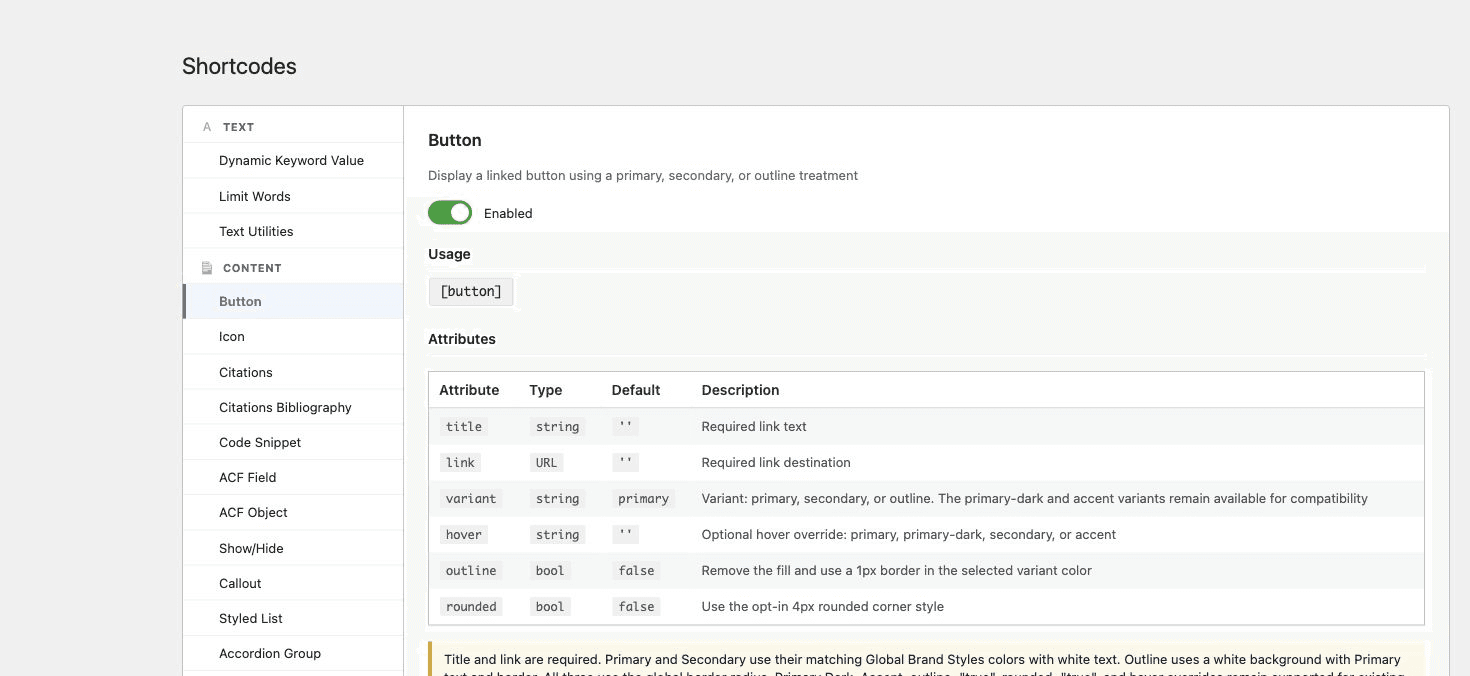
  • Editorial system: Twenty-six managed shortcodes with enablement, documentation, examples, and previews
  • Maps and synchronization: Location compare maps, filters, service-area maps, and Clinical Outreach profile coverage
  • Maps and synchronization: Staff, map, Clinical Outreach, press, and dynamic-keyword synchronization workflows
  • Data and maintenance: Data Porter for complete WordPress records
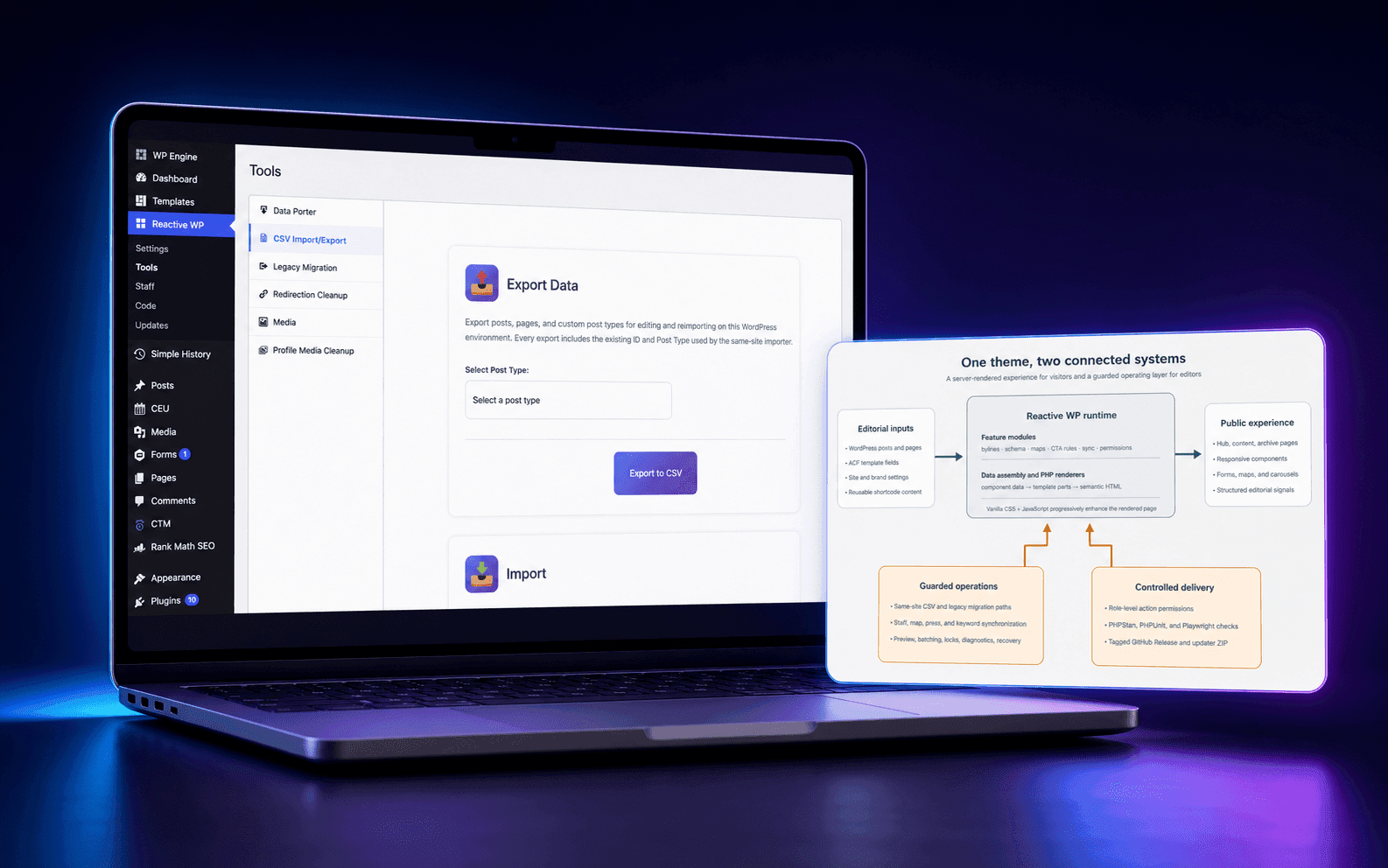
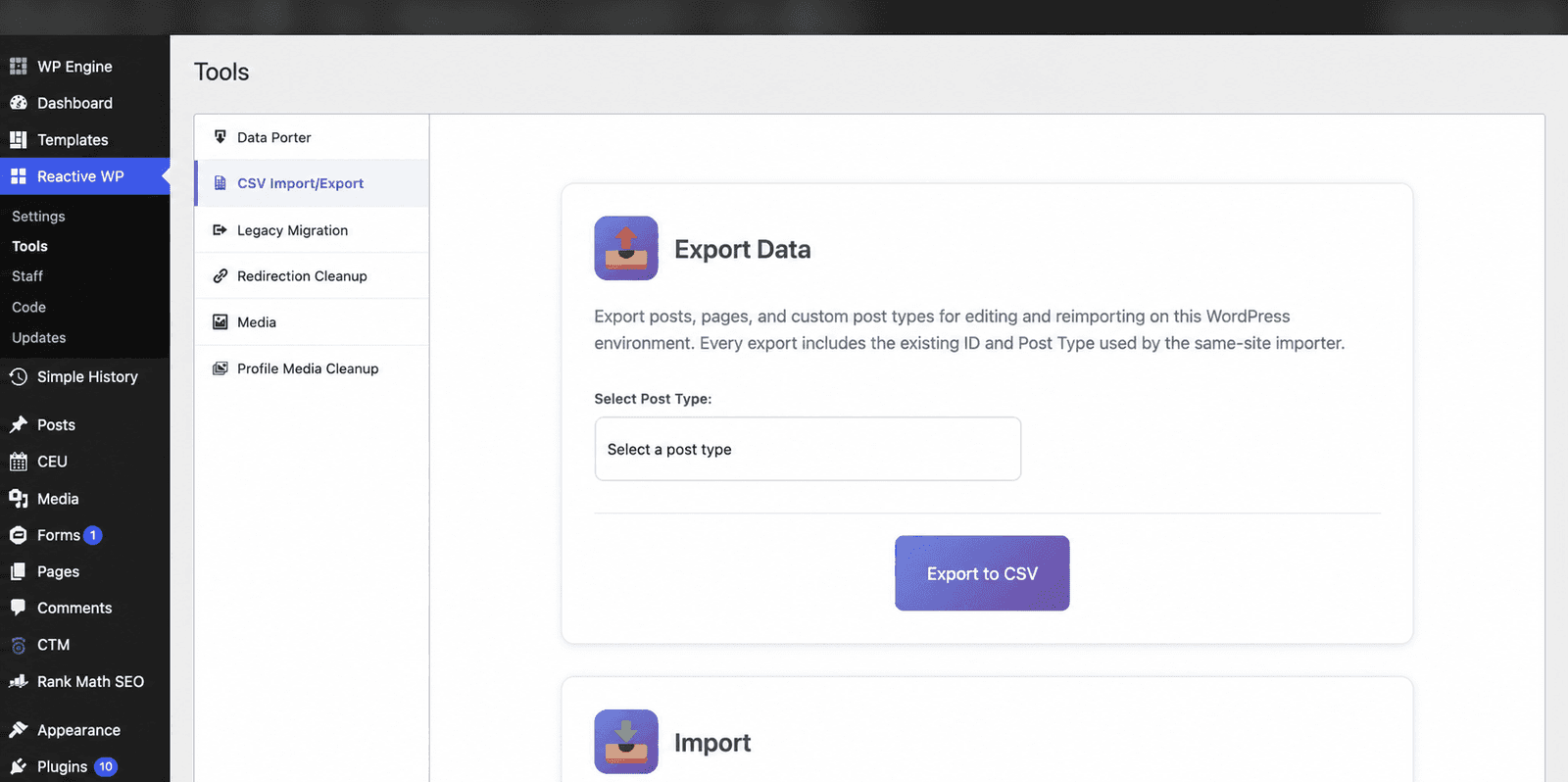
  • Data and maintenance: Separated same-site CSV Import/Export and Legacy Migration workflows
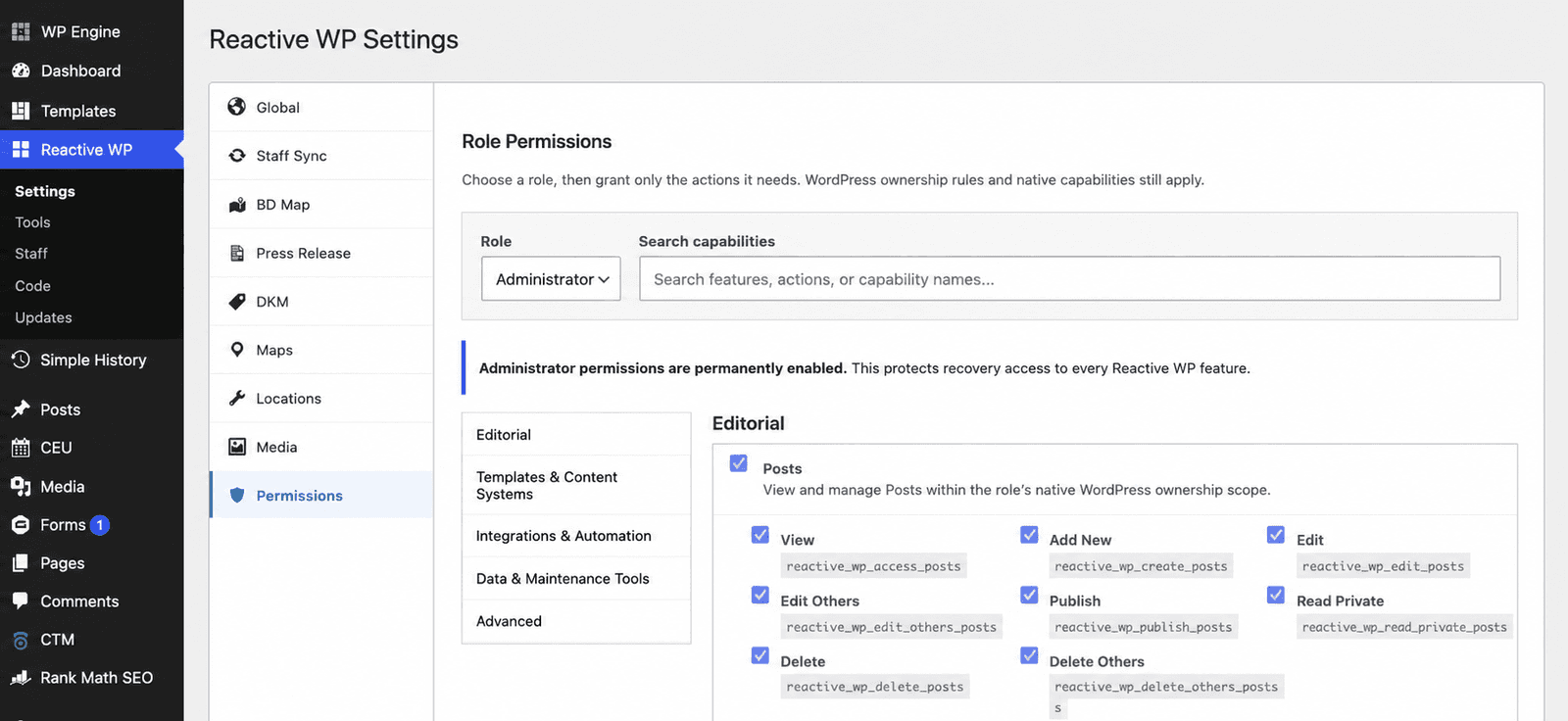
  • Governance and release: Thirty-five permission-controlled feature areas with action-level capabilities
  • Governance and release: Administrator recovery access protected as a permanent invariant

05 / Engineering decisions

Tradeoffs made explicit

The design choices below address compatibility, identity, safety, and maintainability constraints found in the audited implementation.

  • Move from a React-oriented frontend to PHP-first server rendering: Kept the path from WordPress content to HTML direct, reduced runtime/build complexity, and preserved progressive enhancement.
  • Preserve legacy internal identifiers after the public AMFM Core rename: Theme identity, saved options, REST/AJAX contracts, Data Porter exports, and the updater depend on those identifiers.
  • Centralize content primitives in registries and shared renderers: Components, shortcodes, brand settings, CTA rules, and permissions remain discoverable and reusable instead of scattering behavior across templates.
  • Separate same-site CSV work from legacy migration: Different data-trust assumptions require different validation and import contracts.
  • Use action-level permissions rather than broad menu access: Editors and operators can receive only the view, configure, preview, sync, import, export, activate, or delete capabilities they need.
  • Tie deployable artifacts to tags and automated checks: Staging and production can advance deliberately while every updater ZIP remains linked to a verified commit and rollback release.

06 / Verified outcome

A defensible result grounded in inspected evidence

Repository and interface evidence establish the engineering outcome. Production volume, time savings, and business impact remain unclaimed unless separately confirmed.

  • The project progressed from its first commit on 2026-01-15 to release v1.38.9 on 2026-08-27.
  • The v1.38.9 history contains 810 commits attributed to one repository contributor.
  • The release history contains 124 tags merged into v1.38.9.
  • The release contains 26 PHP component partials, 26 managed shortcodes, 19 first-level feature modules, and 35 permission-controlled feature areas.
  • The repository contains 74 PHPUnit test files, 41 Playwright specs, and eight integration scripts.
  • The user-supplied public site served AMFM Core v1.38.4 assets on 2026-08-27.
  • The user-supplied staging admin served AMFM Core v1.38.9 assets and exposed the audited CSV, permissions, and shortcode interfaces.
  • One versioned system now connects public rendering, editorial configuration, operations, permissions, tests, and delivery.
  • New capabilities increasingly enter through established modules, registries, components, permissions, and verification paths rather than parallel implementations.
  • The release model supports deliberate staging and production rollout while preserving a defined rollback version.

Project gallery

Desktop homepage showing branded navigation, a two-column mental-health hero, supporting copy, calls to action, and lifestyle image; the private WordPress toolbar is blurred.
A production homepage rendered by the shared PHP component and brand system.
WordPress admin screen with tabs for Data Porter, CSV Import/Export, Legacy Migration, Redirection Cleanup, Media, and Profile Media Cleanup; the private toolbar is blurred.
The data workspace separates same-site CSV work from legacy migration and other maintenance tools.
AMFM Core permissions screen with role selector, capability search, five permission groups, and the Administrator recovery notice; the private toolbar is blurred.
Action-level permissions protect editor workflows while preserving administrator recovery access.
WordPress shortcode documentation screen with categorized navigation, Button enablement, usage syntax, and attribute table; the private toolbar is blurred.
A central registry gives editors usage, attributes, examples, previews, and enablement for reusable shortcodes.
Desktop facilities page with branded navigation, photographic hero, location introduction, residential-care section, and sticky contact actions; the private WordPress toolbar is blurred.
Reusable page components create a consistent public experience beyond the homepage.
Architecture diagram showing WordPress and ACF editorial inputs flowing through AMFM Core modules and PHP renderers into the public experience, with guarded operations and controlled delivery feeding the runtime.
AMFM Core connects server-rendered publishing with guarded WordPress operations and controlled delivery.

Latest Articles

From the Blog

View all articles
Reactive WP — Website Project — Adzbyte