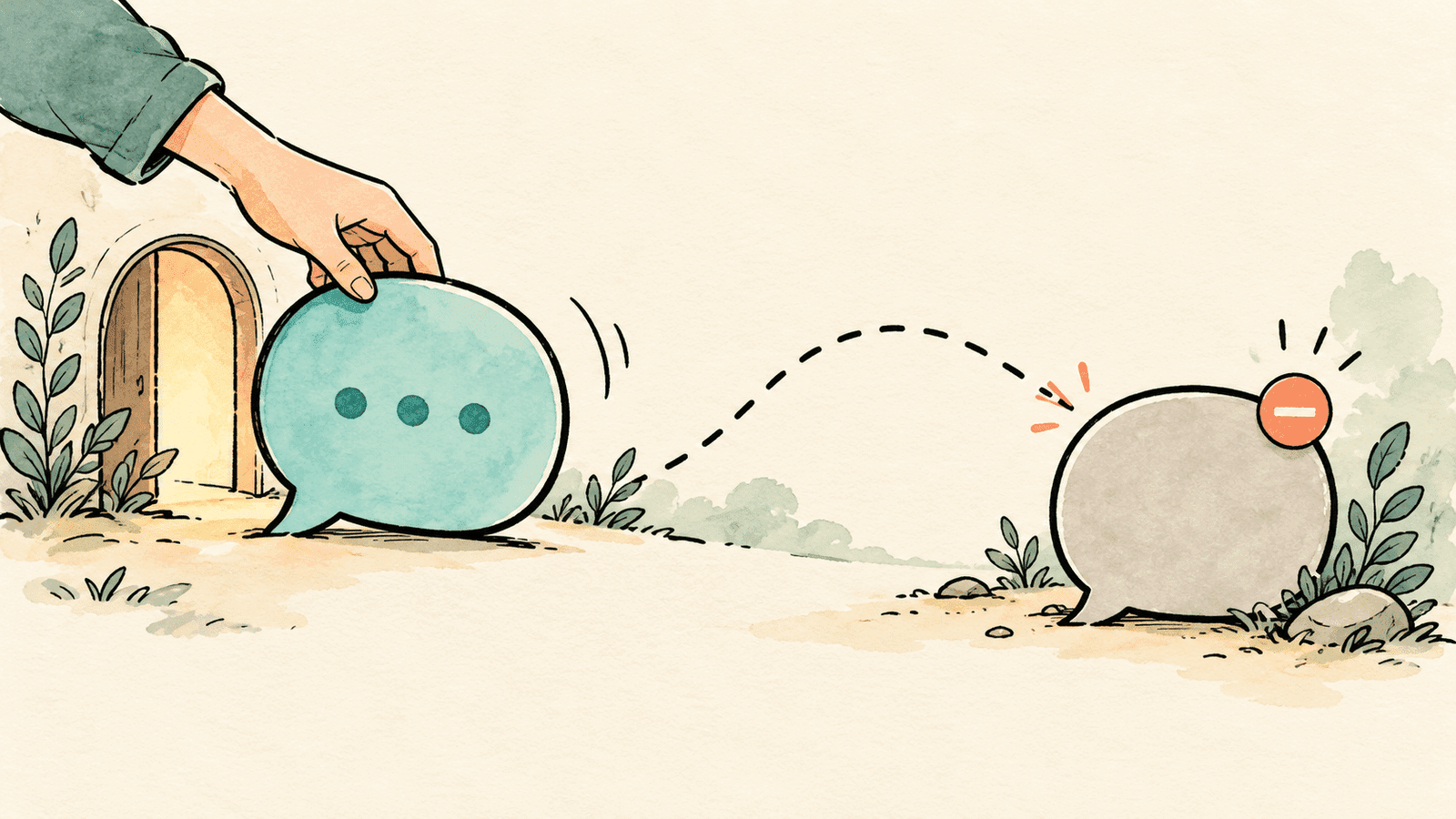
Keep Support Notes Out of Customer Responses


An internal support note can stay out of the message list and still affect what a customer sees. It might move a case to the top of a list, mark it unread, or change a revision that makes the customer’s draft look stale. Privacy needs more attention than hiding one text field.
The support-portal implementation I added to AdzByte App treats public replies and internal notes as different operations. That choice appears in storage, permissions, query paths, and public state. The tests check those differences through both service calls and customer API responses.
Separate the two kinds of writing
Public replies are stored as support messages. Internal notes have their own model and table. Both belong to a case, but the read path doesn’t have to fetch one mixed conversation and remember to filter every private entry afterward.
The command also distinguishes the operations. A staff reply checks reply permission; a staff note checks note permission. A customer request cannot turn its message into an internal note by choosing an input flag.
Separate storage doesn’t make disclosure impossible. A careless query can still load the wrong relationship. It does make the intended audience visible in the model names and the response-building code, which helps reviewers spot a mismatch.
For a new support feature, I’d decide whether it is customer communication, staff collaboration, or a business-state change before deciding where to store it. Reusing a message table is convenient only if the audience rules remain clear everywhere that data travels.
Constrain the record lookup to the customer
The customer case query includes the signed-in user’s ownership constraint before selecting the requested public reference. Staff paths require the appropriate staff access. The code also authorizes the resulting case before returning or changing it.
That means a public-looking identifier isn’t treated as proof of access. The tests request another customer’s work and case directly, try linking that work into a new case, and try sending a message to the other case. Those operations must fail.
One test gives a customer a staff-view capability and still expects the staff path to be denied. The application requires the staff role conditions as well as the capability. An unexpectedly assigned permission shouldn’t turn a customer query into an unrestricted staff query.
Test the link and write paths alongside the detail endpoint. A secure read endpoint doesn’t help much if a create form accepts another customer’s project reference and builds the relationship anyway.
Build the customer response from chosen fields
The read service returns a deliberate array for a support case. It maps public messages into body, author, customer-origin flag, and creation time. Notes are added only on the staff path when the actor has the note capability.
For the customer response, the notes field is absent. The API tests check both that missing field and the absence of a synthetic private note body. Checking only one would be weaker: a body could leak under a different key, or an empty private field could become populated after a later change.
The status timeline is built separately. It selects particular event actions and maps the public status and time rather than returning the full audit-event changes. Internal note bodies and other internal event details don’t belong in that customer timeline.
This is a useful place to resist generic model serialization. An internal model often contains more than the external consumer needs. The response should say which fields belong to the audience rather than rely on every future relationship remaining harmless.
Keep internal activity out of public freshness state
The note command doesn’t increase the case’s public revision, update its public timestamp, or mark the conversation unread for the customer. A public reply does update the corresponding state.
The regression test first marks the case read, adds an internal note, and asserts that the customer still sees it as read. It also checks that the revision remains unchanged. Then it adds a public reply and expects the unread state to change.
That distinction helps the write path too. A customer’s pending message shouldn’t become stale merely because staff added a private note that didn’t change the public conversation. Revision checks should track the state the operation actually depends on.
This doesn’t mean private activity must never affect any shared value. Some internal decisions intentionally change a public status. The important part is choosing that effect explicitly and testing it, rather than inheriting it from a generic timestamp update.
Recheck permissions after they are revoked
The tests don’t stop with a staff user who has every capability. They add a note, revoke note access, and verify that the notes field disappears from the staff read response. Revoking case-view access then prevents the read altogether.
That matters for shared pages and long-lived sessions. A user who opened a page earlier may no longer have the same authority. The server response needs to reflect current access rather than the controls rendered on an earlier visit.
The command tests also check that revoked management access cannot replay a previously accepted operation as a shortcut around the new restriction. Idempotency is useful for retrying work; it shouldn’t preserve an old permission grant.
Test privacy through the complete response
The implementation’s evidence is code and synthetic regressions, not a report of an actual disclosure. It also doesn’t claim support email notifications or attachment delivery. Those would introduce additional outputs that need the same audience review.
When extending this portal, I’d follow each new field through detail responses, lists, unread counts, timelines, exports, and notifications. The existing tests provide concrete examples of what must stay private and what should change publicly.
The useful rule from this work is specific: an internal note stays internal in content and behavior. Separate storage, scoped lookups, explicit response fields, and careful public-state updates make that rule much easier to maintain than a hidden note panel alone.

Written by
Adrian Saycon
A developer with a passion for emerging technologies, Adrian Saycon focuses on transforming the latest tech trends into great, functional products.